서브컨텐츠

Data Room

Safer Workplace for Better Life
Customer

Customer Service

Differences Between DTS and Point Temperature Sensors

페이지 정보

작성자 Woori System 작성일 19-11-14 09:33 View 41 Comment 0

본문

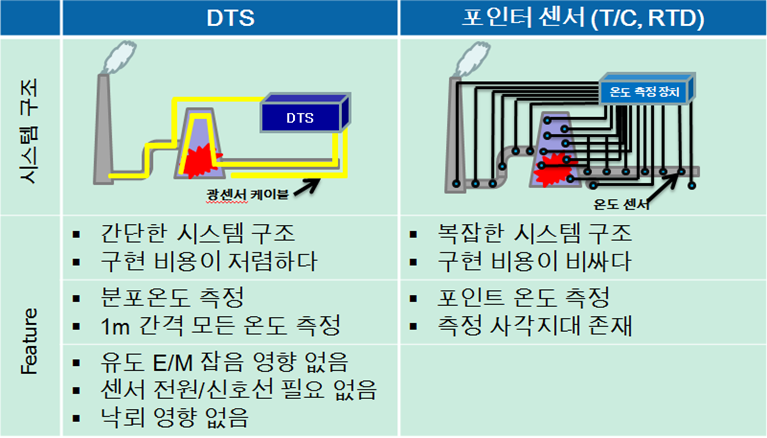
Distributed temperature measurement using DTS offers several advantages over conventional point sensors because of the differences in sensing technology.

Laser pulses are launched into a fiber optic sensing cable. Temperature-sensitive Raman scattering is extracted from the light backscattered by the silica structure and processed using optical time-domain reflectometry (OTDR) to determine temperature.

This approach is particularly useful when many facilities must be monitored across a wide area, or when sensors must be installed in harsh environments where conventional installation is difficult.

DTS features include a simple system structure, low implementation costs, distributed temperature measurement at one-meter intervals, simultaneous measurement at thousands or tens of thousands of points, immunity to induced electromagnetic interference, sensors requiring no electrical power for use in explosion-hazard areas, and immunity of the sensing cable to lightning effects.

Comparison: DTS and point sensors.

Differences Between DTS and Point Temperature Sensors

개인정보처리방침

X

이메일무단수집거부

X
닫기
About Us
Solution
Products
Recruitment
Customer Service
닫기